
2025 Federal Tax Brackets Guide for Individuals & Families
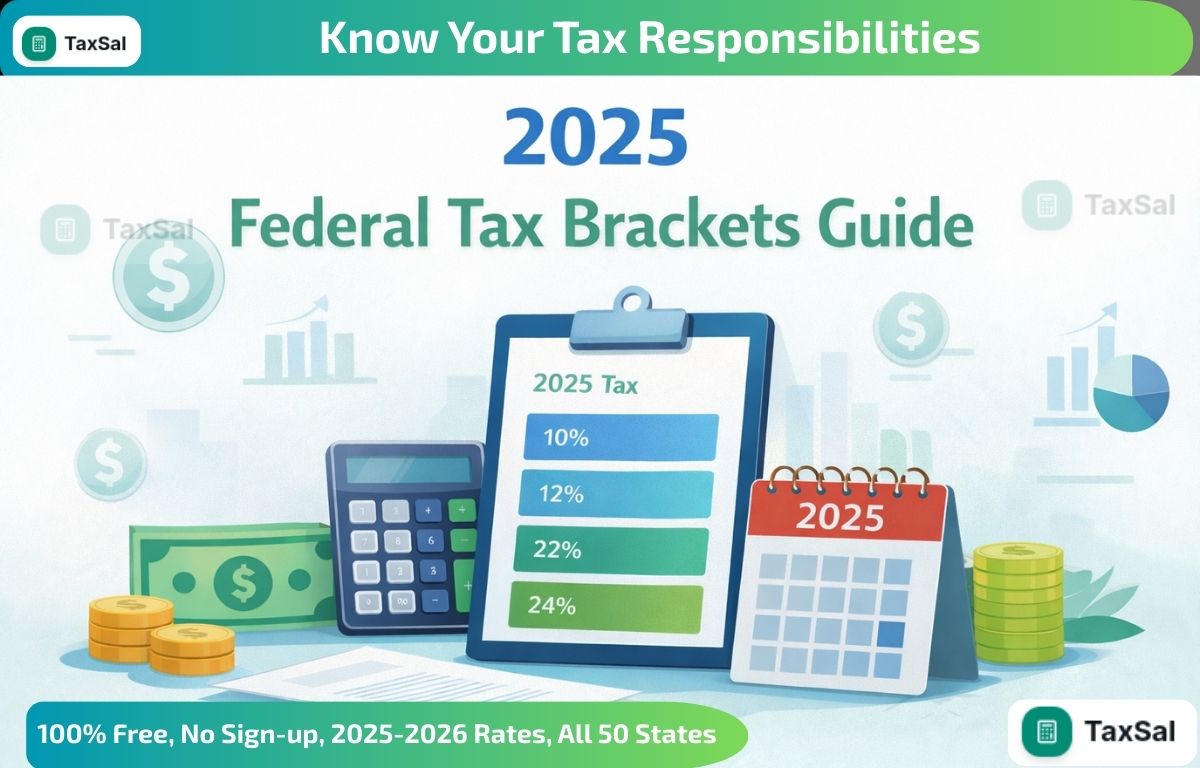
This 2025 Federal Tax Brackets Guide explains updated IRS tax rates, income slabs, filing statuses, and deductions to help U.S. taxpayers calculate their federal taxes accurately.
The purpose of the 2025 Federal Tax Brackets Guide is to assist American taxpayers in comprehending the operation of federal income taxes for the 2025 tax year. Knowing the most recent tax brackets can help you estimate your tax liability and make better financial plans, regardless of whether you are filing as a head of household, married couple, or single person.
Your income is split up into tax brackets under the US tax system, each of which has a different tax rate. The 2025 Federal Tax Brackets Guide states that if you make more money, only the portion of your income that is in the higher bracket will be taxed at a higher rate.
Check More: Tax Brackets
How the 2025 Federal Tax Brackets Guide Helps Taxpayer
2025 Federal Tax Brackets by Filing Status
Tax Rate | Taxable Income (Single Filers) |
|---|---|
10% | $0 – $11,925 |
12% | $11,925 – $48,475 |
22% | $48,475 – $103,350 |
24% | $103,350 – $197,300 |
32% | $197,300 – $250,525 |
35% | $250,525 – $626,350 |
37% | Over $626,350 |
Married Filing Jointly
Tax Rate | Taxable Income |
|---|---|
10% | $0 – $23,850 |
12% | $23,850 – $96,950 |
22% | $96,950 – $206,700 |
24% | $206,700 – $394,600 |
32% | $394,600 – $501,050 |
35% | $501,050 – $751,600 |
37% | Over $751,600 |
Standard Deductions Explained
The significance of standard deductions, which lower your taxable income before tax rates are applied, is also emphasized in the 2025 Federal Tax Brackets Guide.
Filing Status | Standard Deduction |
|---|---|
Single / Married Filing Separately | $15,750 |
Married Filing Jointly | $31,500 |
Head of Household | $23,625 |
Example: Applying the 2025 Federal Tax Brackets
A single filer with $60,000 in taxable income will pay different tax rates on different portions of income using this 2025 Federal Tax Brackets Guide, which will result in a lower effective tax rate than many people anticipate.
Why This 2025 Federal Tax Brackets Guide Matters
Understanding the 2025 Federal Tax Brackets Guide helps taxpayers:
Accurately estimate tax liability
Plan deductions and credits
Avoid underpayment penalties
Make informed financial decisions
2025 Federal Tax Brackets Guide: Step-by-Step Explanation
It can be difficult to understand federal taxes, but this 2025 Federal Tax Brackets Guide breaks it down step-by-step so you can quickly figure out how much tax you owe and why.
Step 1: Determine Your Filing Status
The first step in using the 2025 Federal Tax Brackets Guide is identifying your filing status. The IRS recognizes the following main filing statuses:
Single
Married Filing Jointly
Married Filing Separately
Head of Household
Your filing status directly affects your tax brackets, income limits, and standard deduction amount.
Step 2: Calculate Your Gross Income
Next, calculate your gross income, which includes:
Salary or wages
Self-employment income
Interest and dividends
Rental or other taxable income
According to the 2025 Federal Tax Brackets Guide, all taxable income sources must be combined before deductions are applied.
Step 3: Subtract Adjustments and Deductions
After calculating gross income, subtract adjustments (if any) and deductions to determine your taxable income. As explained in the 2025 Federal Tax Brackets Guide, most taxpayers claim the standard deduction, which reduces taxable income significantly.
This step is crucial because tax brackets apply only to taxable income, not gross income.
Step 4: Match Your Income to the 2025 Tax Brackets
Now use the 2025 Federal Tax Brackets Guide to match your taxable income with the correct tax brackets based on your filing status. Your income will be divided into portions, and each portion will be taxed at a different rate.
This ensures that only income within each bracket is taxed at that bracket’s rate.
Step 5: Apply Marginal Tax Rates
In this step, apply the marginal tax rates shown in the 2025 Federal Tax Brackets Guide. Start with the lowest bracket and move upward until all taxable income is accounted for.
This step explains why your effective tax rate is usually lower than your highest tax bracket.
Step 6: Add Additional Taxes (If Applicable)
Some taxpayers may owe additional taxes, such as:
Self-employment tax
Net investment income tax
Alternative minimum tax (AMT)
The 2025 Federal Tax Brackets Guide helps you understand when these additional taxes may apply.
Step 7: Subtract Tax Credits
After calculating total tax, subtract any eligible tax credits. Unlike deductions, credits directly reduce your tax bill. Common credits include:
Child Tax Credit
Education credits
Energy-related credits
Using the 2025 Federal Tax Brackets Guide, you can see how credits further lower your final tax amount.
Step 8: Review and Plan Ahead
The final step in the 2025 Federal Tax Brackets Guide is planning ahead. Reviewing your tax bracket helps you:
Adjust paycheck withholding
Make estimated tax payments
Reduce future tax liability
Early planning can prevent surprises and penalties at tax time.
Conclusion
A concise and up-to-date summary of federal income tax rates, brackets, and deductions is given in this 2025 Federal Tax Brackets Guide. You can effectively manage your taxes and steer clear of surprises during tax season by remaining informed.
Frequently Asked Questions – 2025 Federal Tax Brackets Guide
Q1: What is the purpose of the 2025 Federal Tax Brackets Guide?
The 2025 Federal Tax Brackets Guide helps taxpayers understand updated IRS income tax rates, brackets, and filing statuses so they can accurately estimate their federal tax liability.
Q2: Are all my earnings taxed at the highest rate?
No. According to the 2025 Federal Tax Brackets Guide, the U.S. uses a progressive tax system, meaning only the portion of income within each bracket is taxed at that rate.
Q3: What income is considered taxable in 2025?
Taxable income is your gross income minus deductions and adjustments, as explained in the 2025 Federal Tax Brackets Guide.
Q4: Do federal tax brackets change every year?
Yes. IRS tax brackets are adjusted annually for inflation, which is why the 2025 Federal Tax Brackets Guide reflects updated income thresholds.
Q5: Does this guide include state taxes?
No. The 2025 Federal Tax Brackets Guide covers only U.S. federal income taxes. State taxes vary by location.
Related Articles
Car Sales Tax Calculator Tennessee (TN) – Estimate Your Vehicle Tax Instantly
Use our Car Sales Tax Calculator to quickly estimate your vehicle tax in seconds. Simple, accurate, and helpful tool to plan your car purchase easily.

How to Calculate Your Tax Refund in 2026 (Step-by-Step Guide)
Learn how to Calculate Tax Refund 2026 quickly and easily with our step-by-step guide. Maximize your refund without hassle!
Tax Refund Estimator Free – No Sign-Up Required
Use our Tax Refund Estimator Free tool to quickly calculate your potential tax refund. Fast, accurate, and easy to use for everyone